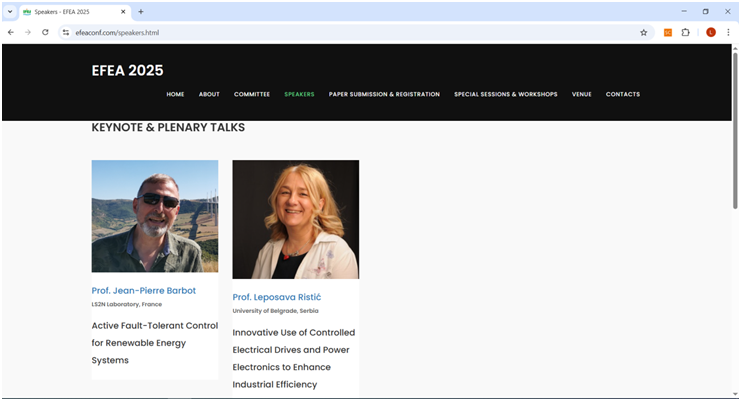
written by Leposava Ristić
This lecture was particularly close to my heart, as it gave me the opportunity to share not only technical results, but also the broader story, philosophy, and very concrete achievements of the Twinning project SUNRISE.
I should confess right away: the lecture was long. Very long. But in my defense, the topic deserved it. I felt it was absolutely necessary to explain all the details related to the field and to the Twinning project – because complex ideas rarely fit neatly into a few slides and a stopwatch. From the very beginning, my goal was clear: say everything that matters.
I spoke about how advanced controlled electrical drives and power electronics can dramatically improve energy efficiency, flexibility, and overall industrial performance. I emphasized the principle of minimizing energy losses through functional adjustment of drive components and optimization at the level of individual subsystems. Naturally, variable speed drives (VSDs) received special attention – because once you start talking about regulating speed and torque according to real process needs, it is very hard to stop.
By integrating advanced control algorithms and modern power electronic devices, electrical drives achieve high precision, fast dynamic response, improved power factor, and better load management. And just when I thought I was wrapping up, smart grids entered the conversation – followed closely by demand response, energy management strategies, and sustainability. At that point, the moderator gently reminded me that time was passing. I nodded politely… and continued talking.
In parallel, I introduced Hardware-in-the-Loop (HIL) concepts, including C-HIL and P-HIL architectures, supported by practical demonstrations from the SUNRISE Lab, real-time simulations, and Digital Twin implementations. This was another moment when the moderator intervened – this time less gently – to remind me that I was approaching the time limit. Once again, I acknowledged the warning, smiled, and carried on. Some stories simply refuse to be rushed.
In the end, I achieved a small personal victory: I managed to say everything I had planned. The clock may not have approved, but I certainly did. Even better, after the lecture, several participants approached me with positive feedback, telling me how much the work done within the SUNRISE project had captured their interest – especially the possibilities offered by the smart grid laboratory and the Digital Twin concept. That was the moment I knew my “extended version” had been worth it.
This keynote lecture was closely linked to WP5 of the SUNRISE project and contributed directly to its objectives: strengthening excellence at the Faculty of Electrical Engineering (ETF) in the field of energy transition toward decarbonisation, and increasing the visibility and research profile of both the institution and its staff.
Looking back, this keynote reminded me that while conference schedules are important, passion for one’s work can occasionally bend the rules – just a little. And if enthusiasm happens to spill over the allotted time, it might simply mean that the story was worth telling.